UEFI Captures Boot Info
Hardware
UEFI firmware captures device info and stores it in an SMBIOS file in ACPI memory. After boot, the OS grabs the info from the SMBIOS file and stores it in Class Registries.
Firmware
As the computer boots, UEFI has each stage of boot software measure the next stage before it loads. A measurement is a hash (or digest) of that software. Examples of measured components include:
- Code
- Configuration files
- Cryptographic keys
- ACM tables
Each measurement is:
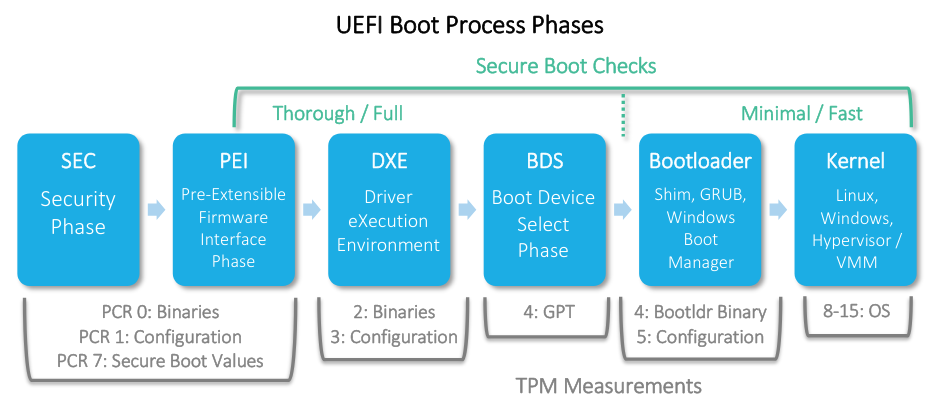
- Extended into a TPM Platform Configuration Register (PCR) slot, per the image below
- “Extending” is a one-way cryptographic operation that combines the new measurement with the current PCR value. Each PCR value reflects a cumulative chain of all prior measurements.
- PCRs are registers within the TPM and cannot be directly modified without detection during the verification process.
- Most TPMs have 24 PCRs per supported hash algorithm. TPM 1.2 supports SHA-1 (24 PCRs). TPM 2.0 supports SHA-1 and SHA-256 at the minimum (48 PCRs minimum).
- Because the operation is one-way, individual measurements cannot be removed or reversed (i.e. by malicious actors).
- Captured and recorded in the TCG Event Log
- Each TCG Event Log entry includes the measurement (hash) and a description of what was measured.
- The TCG Event Log is stored in the UEFI partition on the device’s primary drive.
The image below shows the interaction of Secure Boot and TPM with UEFI boot phases:
When the OS loader launches, the device hands the TCG Event Log to the OS. The OS:
- Copies the TCG Event Log to an OS-specific location during boot
- Extends its own measurements into dedicated TPM PCR slots
- Appends those measurements to the Event Log
- As a result, the original firmware Event Log does not include OS-level measurements.
Applications and drivers can also extend runtime hashes to dedicated TPM PCRs, but the original firmware Event Log does not include these either as they occur at a later time.